
Most of us know the feeling of walking into a large venue and within minutes getting completely lost. Oddly enough, this often happens in buildings full of directories and signs. Getting lost does not mean someone is careless or has troubles understanding directions. In fact, it usually comes down to how our brains work and how architects design buildings. In this post, we look at why indoor navigation is so challenging for many people. Following that, we explain how interactive maps can help.
Indoor Navigation and Our Brains
Generally, people find their way by building a mental map of their surroundings. Outdoors, this task feels fairly easy. The sky, distant landmarks, and the position of the sun are elements that help us build this map. However, most of these clues disappear indoors. Long corridors look similar to each other, and walls conceal everything in further distance. Similarly, many floors share the same layout, so the third floor can look exactly like the second. As a result, our mental map can become misleading or stay incomplete. Additionally, people differ a lot in their spatial skills. Some visitors picture a building easily, whereas others need clear, step-by-step guidance. Therefore, a good indoor navigation system has to work for everyone.
Stress and Tricky Decision Points
Stress makes everything harder, especially in places like hospitals and airports. To illustrate, a patient might rush to an appointment, while a traveller worries about boarding. In this case, the brain focuses on the worry and pays less attention to the surroundings. Consequently, people might miss signs that they’d normally notice. In addition, decision points add another layer of difficulty to indoor navigation. For example spots like junctions, lift lobbies or entrances require choosing a direction, and complex buildings may contain dozens of them on a single route. Each choice gives the visitor another chance to take a wrong turn. Moreover, one mistake often leads to another, because a person who is lost starts guessing more.
Where Signs Fall Short, Maps Step In
Admittedly, traditional signs still play an important role in indoor navigation. But they have clear limitations that prevent them from being an effective guide by themselves. To illustrate, a sign can only depict a limited amount of information at once. They also stay fixed to certain spots, which means making use of them requires being in the right place at the right time. In addition, changes in the venue can also mean an inherent replacement or modification of the sign. For this reason, visitors relying only on signage can still find themselves lost.
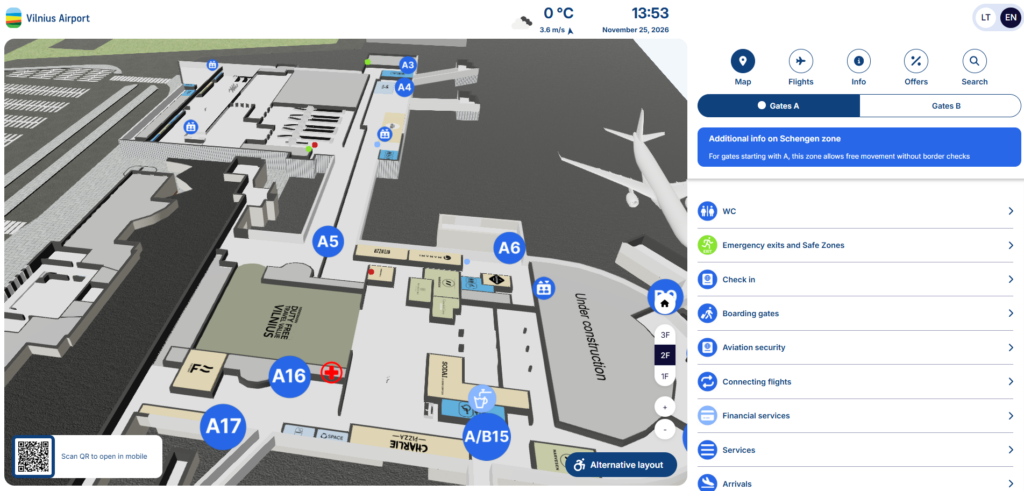
A good example from the transport sector is the map of Vilnius Airport that we created. It is intuitive, and every aspect has been very carefully thought through. It is easy for airport visitors to use and proves highly helpful during busy or complex moments.
Interactive Tools and Indoor Navigation
This is where interactive tools take indoor navigation a step further. Instead of showing one arrow at a time, they depict the entire building. A visitor can select or search for any destination in the building and see the exact route there. Additionally, a 3D view makes floors, stairs and lifts easier to understand, particularly in multi-level buildings. Likewise, a 2D map gives a clean overview for people who prefer simplicity. Therefore, visitors can build a correct mental map before they even start navigating the building. Besides, digital maps update quickly when the building changes. If a department moves, the map can show the new location the same day.
In conclusion, people get lost indoors for very human reasons. Our brains struggle without outdoor landmarks, and stress narrows our attention even further. Apart from this, every junction gives us another chance to go the wrong way. Signs help, but they cannot show the full picture or adapt to every visitor. Interactive maps, on the other hand, help people understand the building as a whole. In general, better indoor navigation means calmer visitors and fewer wrong turns. At 3D Wayfinder, we build interactive 2D and 3D maps that help people find their way with confidence.