
Picture a traveller who needs a phone charger before a long flight. They don’t care which store sells it. In fact, they just want the nearest shop that has one on the shelf right now. Traditional directories list stores by name or category. In contrast, product-based wayfinding flips that logic. A visitor searches for the item itself, and the map guides them to a retailer that actually has it in stock. As a result, people spend less time wandering and more time buying.
How It Works
Most wayfinders only let visitors search for retailer names and destinations. Product search, in contrast, starts from what the visitor actually wants to buy. It works in three ways. First, a category search for “headphones” shows every store that sells them. Second, a brand search finds each shop that carries a given label, not just the flagship. Finally, a name search looks for one exact item, for example a specific phone model. The system then checks the live inventory of every connected store and draws the route on the map. If several retailers stock the item, the visitor sees all of them side by side. Along with store names, the results display prices, opening hours and product details. Consequently, the shopper can compare options before taking a single step.
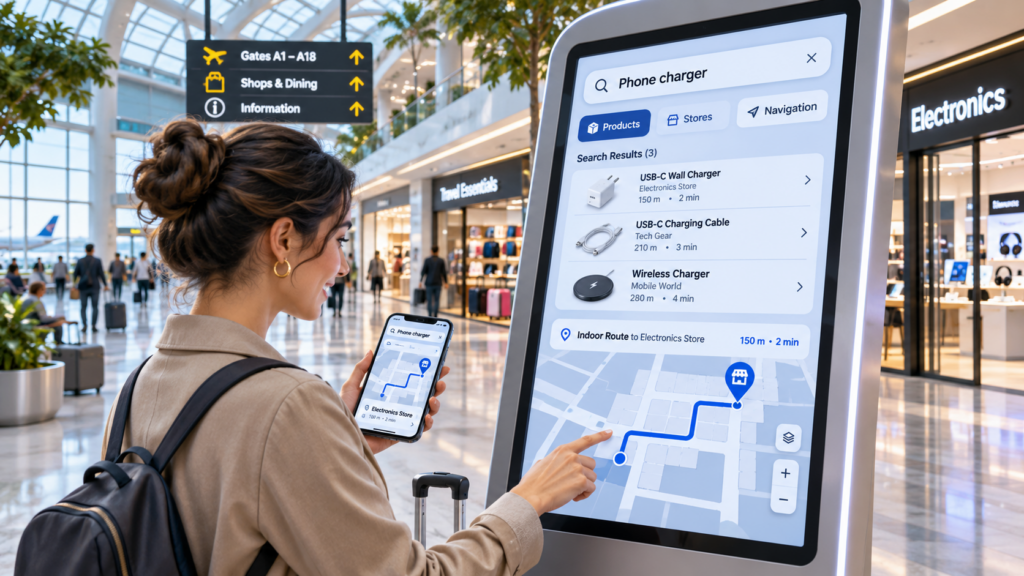
Unlike a static directory, the results update as stock levels change throughout the day. Retailers can also push live promotions, so discounted items stand out in the results. But what if nothing in the building has the item? In that case, the system suggests similar products that stores do have in stock. Besides, visitors don’t need to memorise the route. A QR code on the kiosk hands the search to their phone, complete with map and product card. Hence, they can keep browsing while they walk.
Connecting to Store Databases
Behind the search box sits the real engine: data integration. The wayfinding platform connects to each retailer’s inventory or point-of-sale system through an API. Thus, when a store sells its last pair of running shoes, the kiosk stops sending people there. Admittedly, this takes real work, because every POS system has its own data model. For this reason, many projects use middleware or services that already link thousands of stores. Retailers also need to agree on what they share, such as stock counts, prices and promotions. Above all, the data must stay fresh. In most cases, a nightly full refresh plus instant updates after each sale keeps results accurate.
Benefit of Product-Based Wayfinding
For visitors, the benefit is obvious: they find what they need fast. Retailers, on the other hand, gain ready-to-buy customers who walk straight to their door. Smaller shops, in particular, get visibility they rarely have next to big anchor brands. In addition, a tenant-facing dashboard turns every search into useful data. For instance, it shows which products people look for but can’t find anywhere in the building. Seasonal patterns appear there too, like sunscreen searches rising before summer holidays. Such insights help leasing teams spot gaps in the tenant mix. Similarly, retailers can plan stock and campaigns around real demand.
To sum up, product-based wayfinding answers the question visitors actually ask: “Where can I get this?” Destination, product and brand search together cover almost every need. The platform connects the map to live store data, so every route leads to a real product on a real shelf. Shoppers save time, retailers gain customers, and venue owners learn what their visitors want. Overall, it turns a simple wayfinder into a tool that drives sales. If your mall, airport or another similar venue is ready to take that step, 3D Wayfinder can help you plan it.