
Wayfinding screens do much more than guide visitors to their destinations. They usually stand in busy and highly visible locations throughout shopping centers, airports, hospitals, universities, offices, and other large venues. Therefore, these screens also provide valuable opportunities for digital advertising. With wayfinding screen advertising, venue owners can create an additional source of revenue while continuing to offer visitors a useful navigation service. For example, the same screen that displays maps and directions can also promote stores, restaurants, services, events, or special offers. As a result, a wayfinding solution no longer represents only an operational cost. Instead, it becomes a digital communication channel that can support tenants, improve the visitor experience, and help the venue generate a return on its technology investment.
Why Wayfinding Screens Offer Valuable Advertising Space
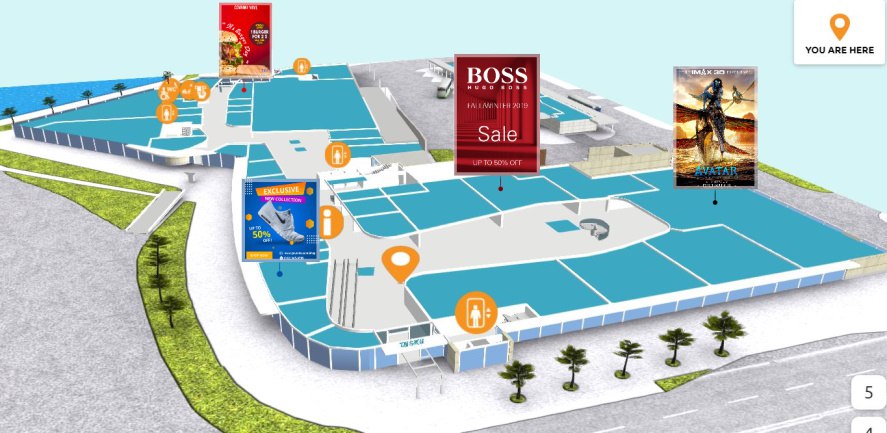
Wayfinding kiosks attract attention because visitors actively use them to find information. Unlike many traditional advertising displays, these screens already have a clear purpose and a steady audience. Visitors may search for a store, meeting room, departure gate, hospital department, or available service. During this interaction, the screen can present relevant advertising content alongside the navigation information.
Furthermore, wayfinding screens often stand near entrances, elevators, reception areas, and major intersections. These locations naturally receive high visitor traffic. Consequently, advertisements displayed on these screens can reach a large and relevant audience without requiring additional digital signage hardware. The venue can also manage maps, navigation content, and advertisements through the same system. This makes campaign management easier and allows operators to update advertising content whenever necessary.
Static and Rotating Advertisements
Static banners provide one of the simplest ways to introduce advertising to a wayfinding screen. A venue can place a banner next to the map, below the search results, or in another dedicated section of the interface. For instance, a restaurant may promote a lunch offer, while a retail store may advertise a seasonal discount. A business can reserve the advertising position for a fixed period, such as one week or one month. Rotating advertisements offer even more flexibility. Instead of showing one advertiser continuously, the screen can cycle through several campaigns. Therefore, multiple businesses can share the same advertising space at different times.
Venue managers can also create different pricing levels based on screen location, display frequency, and campaign duration. For example, screens near main entrances or elevators often receive more attention and may justify a higher advertising price. Most importantly, this type of wayfinding screen advertising does not require a separate display network. The venue can use its existing screens and manage the campaigns through the wayfinding platform.
Schedule Advertisements by Date and Time
In addition to choosing where advertisements appear, venue managers can control exactly when each campaign runs. 3D Wayfinder allows to schedule advertisements according to specific dates, weekdays, and time periods.
For example, a venue can display a particular advertisement every Saturday from 1:00 PM to 4:00 PM. Similarly, it can schedule another campaign to run every Tuesday during a selected time period. Therefore, advertisers can reach visitors when their message is most relevant.
A restaurant could promote a weekend lunch offer only on Saturdays, while a store could advertise a Tuesday discount throughout its opening hours. Likewise, a venue could schedule event promotions to appear only during the days leading up to the event. Furthermore, managers can prepare campaigns in advance and define clear start and end dates. Once the campaign period ends, the system can automatically stop displaying the advertisement. This reduces manual work and helps prevent outdated promotions from remaining on the screens.
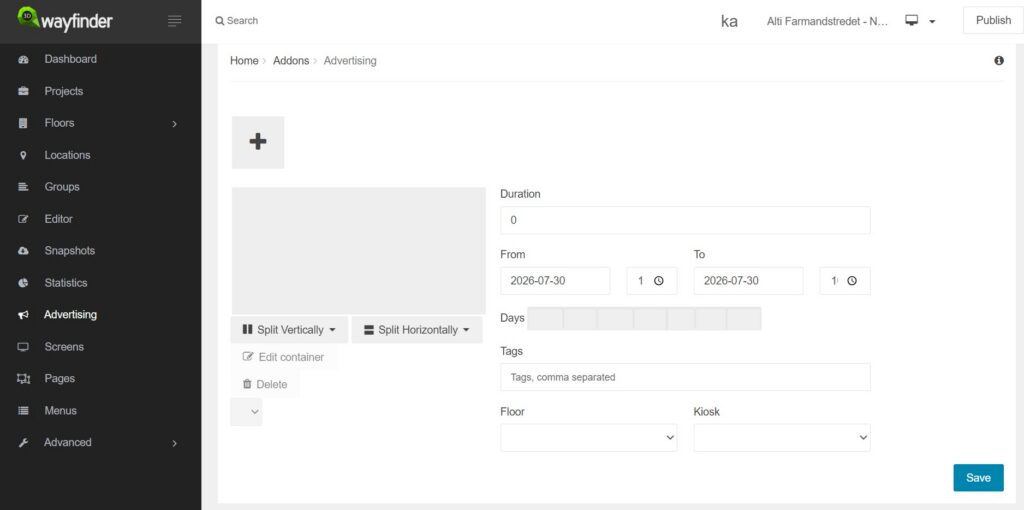
Time-based scheduling makes wayfinding screen advertising more flexible and valuable. As a result, venues can sell advertising packages based not only on screen location and display frequency but also on specific days and peak visitor hours.
Advertisements Based on Visitor Searches
Wayfinding systems can also connect advertising content with visitor searches. For instance, when someone searches for a specific store category, the screen could display a relevant offer from a nearby business. A visitor searching for sports shops might see a campaign from a sporting goods retailer. Likewise, someone looking for restaurants could receive information about current lunch offers or available table reservations.
However, the advertisement should never interrupt the main navigation task. Visitors must still receive clear search results and accurate directions. Therefore, the system should place promotional content in a way that supports the experience rather than distracts from it. When implemented carefully, search-related advertising can help visitors discover relevant services while giving businesses a stronger promotional opportunity.
Promoting the Venue’s Own Services
Not every advertisement needs to come from an external advertiser. Venues can also use wayfinding screens to promote their own services, events, and announcements. For instance, a shopping centre may advertise upcoming events, loyalty programmes, gift cards, or extended opening hours. An office building could promote meeting rooms or shared services. Meanwhile, a hospital could share information about visitor facilities or health campaigns.
This content can also fill advertising space when no paid campaign is active. Therefore, the screen remains useful and visually engaging throughout the day. In addition, venues can adjust campaigns according to seasons, events, and visitor flows. This flexibility makes wayfinding screens valuable tools for both advertising and general communication.
Managing Advertising with 3D Wayfinder
3D Wayfinder allows venue managers to combine digital navigation with visual communication and advertising opportunities. Administrators can manage content centrally and display different campaigns across selected kiosks or screen locations.
The system can support advertisements within the user interface, on map views, and during periods when visitors are not actively using the screen. As a result, each venue can create an advertising model that fits its design, audience, and commercial goals. At the same time, the navigation experience must remain simple, fast, and accessible. Advertising works best when it complements the interface instead of competing with maps, search results, and directions.
Turn Wayfinding Screens into Revenue-Generating Tools
In conclusion, wayfinding screen advertising can transform a navigation solution into a valuable commercial and communication channel. Static banners offer an easy starting point, while rotating campaigns allow several advertisers to share the same space.
Furthermore, location-based promotions, sponsored points of interest, and relevant route recommendations can provide even greater value. Venues can also use the screens to promote their own events, services, and announcements. Because wayfinding screens already stand in visible, high-traffic locations, venues can introduce advertising without installing a completely separate display network. Consequently, the existing wayfinding solution can support visitors while generating additional revenue.
For 3D Wayfinder clients, this means that a navigation platform can do more than help people find their destination. With the right advertising strategy, it can also help the investment pay for itself. If you would also like to increase your income through wayfinding, please contact us.